
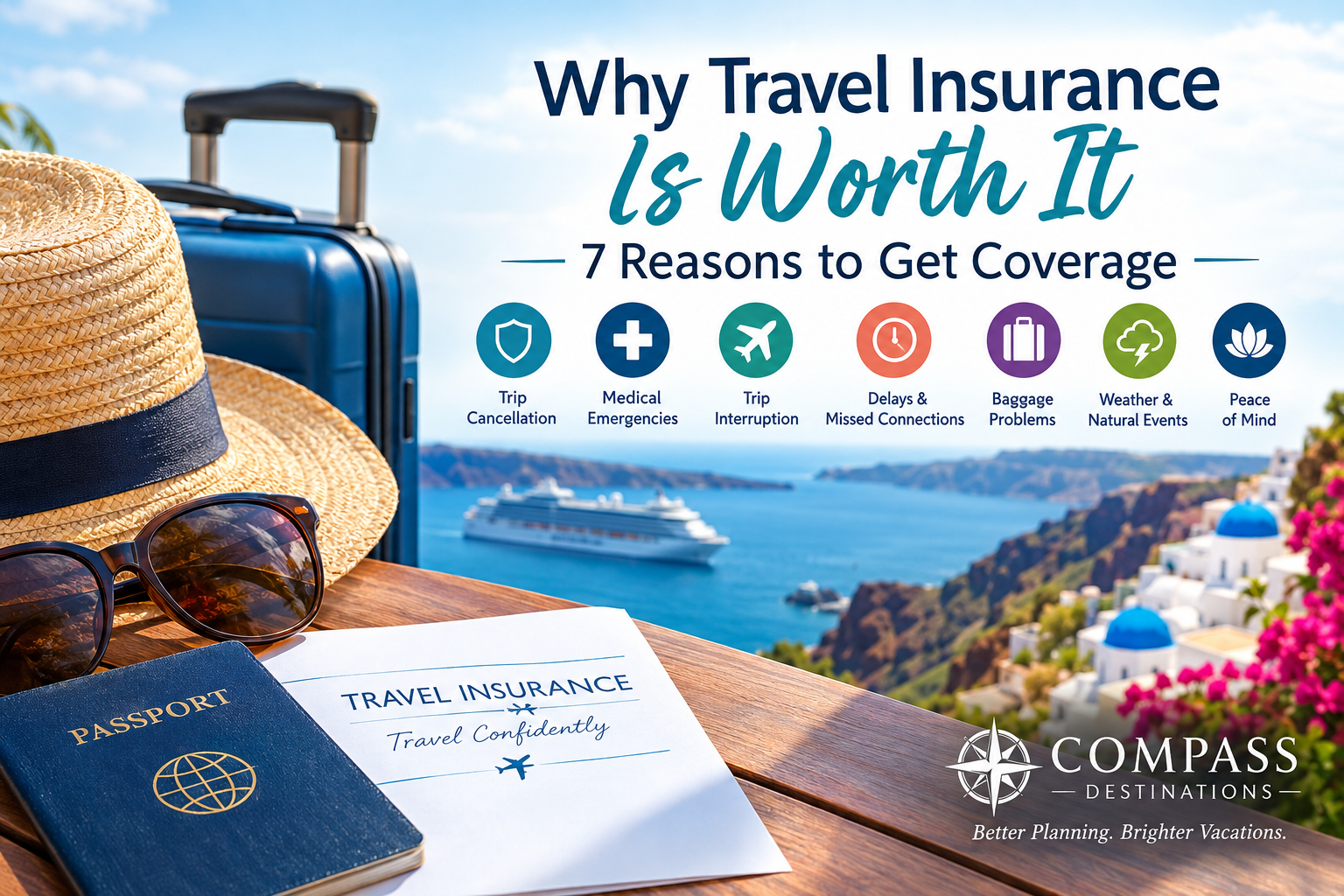
Why Travel Insurance Is Worth It: 7 Reasons Every Traveler Should Consider Coverage
Planning a vacation is exciting. You spend weeks—or sometimes months—choosing the perfect destination, comparing hotels and resorts, selecting excursions, and looking forward to finally getting away from everyday life.
But what happens when something goes wrong?
A flight is canceled. A family member becomes seriously ill. Your luggage disappears. A hurricane disrupts your cruise. You have to cut your vacation short because of an emergency at home.
These situations may be the last thing you want to think about when planning your dream vacation, but they are exactly why travel insurance is worth considering.
As a travel advisor, I highly recommend that my clients consider travel insurance for every trip, especially vacations that involve significant non-refundable expenses. Travel insurance isn't about expecting something to go wrong. It's about protecting yourself financially if the unexpected happens.
In this guide, we'll look at seven important reasons to consider travel insurance, what travel insurance may cover, and why having the right protection can give you valuable peace of mind before and during your vacation.
What Is Travel Insurance?
Travel insurance is designed to help protect travelers against certain unexpected events that can occur before or during a trip. Depending on the plan you purchase, coverage may include things such as trip cancellation, trip interruption, emergency medical expenses, baggage problems, travel delays, and emergency assistance.
The important thing to remember is that not every travel insurance policy covers the same things.
Coverage, exclusions, limits, deductibles, eligibility requirements, and definitions can vary considerably between plans. That's why I recommend reviewing the details of a policy before purchasing it rather than simply choosing the cheapest option.
Think of travel insurance as another part of your vacation budget—similar to purchasing airfare, reserving your hotel, or adding an excursion. You're paying for protection against certain risks that could otherwise cost you substantially more.
1. Travel Insurance Can Protect Your Non-Refundable Vacation Investment
One of the biggest reasons to consider travel insurance is to protect the money you've invested in your vacation.
Many vacations involve substantial prepaid, non-refundable expenses. A cruise, for example, may include the cruise fare, airfare, hotels, excursions, transportation, and other arrangements.
If you have to cancel your trip for a covered reason, you may otherwise lose some or all of those prepaid expenses.
Depending on the policy and the circumstances, trip cancellation coverage may reimburse eligible prepaid, non-refundable trip costs when you cancel for a covered reason.
For example, imagine you've spent $8,000 planning a family vacation. Several weeks before departure, a close family member experiences a serious medical emergency and you can no longer travel.
Without appropriate coverage, your vacation supplier's cancellation policy may determine how much of your money you can recover.
With a travel insurance policy that includes applicable trip cancellation coverage, you may be able to recover eligible expenses according to the policy's terms and conditions.
That's a significant difference.
Why this matters for cruises
Cruises are particularly good examples of why travelers should consider insurance. Cruise fares can be expensive, and cancellation penalties generally become more restrictive as the sailing date approaches.
The closer you get to departure, the more important it can be to understand what would happen financially if you suddenly couldn't travel.
2. Medical Emergencies Can Be Extremely Expensive
Perhaps the most important reason to consider travel insurance is emergency medical coverage.
Many travelers assume their regular health insurance will cover them wherever they travel. Unfortunately, that's not always the case.
Your health insurance may have limitations when you're traveling outside your normal service area, and Medicare generally doesn't provide coverage for medical care outside the United States except in very limited circumstances.
International travelers face an even bigger concern.
A medical emergency in another country can potentially result in significant out-of-pocket expenses. Depending on the destination and situation, travelers could face costs for hospitalization, physician services, ambulance transportation, or other emergency treatment.
A travel insurance policy with emergency medical coverage may help cover eligible medical expenses, subject to the policy's limits and exclusions.
And that's not just important for international travel.
Even on a domestic vacation, an unexpected medical problem can disrupt your plans and create additional expenses.
Don't forget about emergency medical transportation
Another potentially important benefit is emergency medical evacuation coverage.
If you're traveling in a remote destination and experience a serious medical emergency, you may need transportation to an appropriate medical facility. Depending on the circumstances, that transportation can be extraordinarily expensive.
Some travel insurance plans include emergency medical evacuation benefits that may help cover eligible transportation costs.
This is one area where the value of travel insurance can become very apparent very quickly.
3. Travel Insurance Can Help When You Have to Interrupt Your Trip
Not every travel problem happens before you leave.
Sometimes the trip starts perfectly—and then something unexpected happens while you're away.
You may need to return home because of a covered emergency involving a family member. You could experience an illness or injury that requires you to end your vacation early. A covered event could force you to leave your destination before your planned return date.
This is where trip interruption coverage can potentially help.
Depending on the policy, trip interruption coverage may reimburse certain unused prepaid trip expenses and additional transportation costs associated with returning home early for a covered reason.
Consider a two-week European vacation costing $10,000.
You make it through the first week without a problem. Then you receive news of a serious emergency at home and have to return immediately.
Without insurance, you could lose the money you've already paid for the unused portion of your trip and potentially have to purchase an expensive last-minute flight home.
With appropriate trip interruption coverage, some of those eligible expenses may be covered.
Again, the specific reason for the interruption must qualify under the policy.
4. Travel Delays and Missed Connections Can Become Expensive
Travel delays are frustrating.
They're even worse when they cause you to miss your cruise departure.
Imagine flying to Miami the day your cruise departs. Your flight is delayed for several hours because of a covered reason. By the time you arrive, your ship has already sailed.
Unfortunately, the cruise ship isn't going to wait for a delayed passenger.
Now you're faced with figuring out how to get to the next port—and paying for it.
Depending on your travel insurance plan, travel delay and missed connection benefits may provide reimbursement for certain eligible expenses.
Coverage could potentially include things such as meals, accommodations, transportation, or other expenses resulting from a covered delay.
For cruise travelers, this is one reason I frequently recommend arriving at the embarkation city at least one day before the cruise whenever practical.
A pre-cruise hotel stay can reduce the risk of a same-day flight delay causing you to miss the ship.
Travel insurance can provide another layer of financial protection.
5. Lost, Stolen, or Delayed Baggage Can Disrupt Your Vacation
Few things can ruin the beginning of a vacation faster than discovering your luggage didn't make it.
You arrive at your destination. Your suitcase doesn't.
Now you're left without clothing, toiletries, medications, or other necessities.
Depending on the policy, baggage loss, theft, or delay coverage may help reimburse travelers for eligible expenses.
For example, some plans may provide reimbursement for essential items purchased when baggage is delayed for a specified period.
Baggage coverage can also potentially help if covered personal belongings are lost, stolen, or damaged, subject to the policy's limitations.
This doesn't mean you should pack your most expensive jewelry in your checked suitcase, however.
Travelers should always review coverage limits and exclusions for high-value items and consider whether additional protection is appropriate.
6. Weather and Natural Events Can Disrupt Your Vacation
Mother Nature doesn't care about your vacation plans.
Hurricanes, severe storms, wildfires, earthquakes, and other natural events can disrupt travel plans in ways that are impossible to predict.
This is especially relevant for travelers taking cruises or visiting destinations during hurricane season.
A storm can result in:
- Flight cancellations
- Airport closures
- Cruise itinerary changes
- Hotel closures
- Evacuations
- Travel delays
- Missed connections
- Changes to transportation arrangements
Travel insurance may provide certain benefits when a covered weather-related event affects your trip.
However, there's an important distinction travelers need to understand:
Travel insurance is not designed to cover every possible weather event automatically.
The event generally must meet the policy's definition of a covered event, and other conditions may apply.
This is why purchasing insurance before a storm or other known event becomes a problem is so important.
Once an event is known or reasonably foreseeable, purchasing a policy afterward generally won't provide coverage for that already-known situation.
7. Travel Insurance Provides Something Just as Valuable as Financial Protection: Peace of Mind
This is perhaps the simplest reason to consider travel insurance.
Peace of mind.
When you've invested thousands of dollars into a vacation, it's natural to worry about what could happen.
What if I get sick?
What if my flight is canceled?
What if there's an emergency at home?
What if my luggage is lost?
What if I have to come home early?
You can't eliminate those risks.
But having an appropriate travel insurance policy can help reduce the financial impact of certain unexpected situations.
That's especially valuable for expensive vacations such as cruises, European vacations, all-inclusive resorts, escorted tours, and family trips.
For many travelers, knowing they have assistance available if something goes wrong is worth the cost of the policy.
When Should You Buy Travel Insurance?
One of the most common questions I hear is: "When should I buy travel insurance?"
In general, I recommend considering it as soon as you make your first non-refundable trip payment.
There are several reasons for this.
Some policies have time-sensitive benefits or eligibility requirements. Certain benefits may only be available if the policy is purchased within a specified period after your initial trip deposit.
For example, some policies may offer certain pre-existing medical condition waivers if you purchase the policy within a particular time frame and meet the plan's requirements.
If you wait until shortly before departure, you could miss out on benefits that might have been available earlier.
There's also a simple practical reason:
The longer you wait, the longer you remain financially exposed.
If you put down a $1,000 non-refundable deposit today and wait six months to purchase travel insurance, that $1,000 is potentially at risk during those six months.
Is Travel Insurance Worth It for a Cheap Trip?
This is a personal decision.
If you're taking a weekend road trip that costs a few hundred dollars and most of your reservations are refundable, you may decide the cost of insurance isn't worthwhile.
But consider the potential cost of an emergency.
Even a relatively inexpensive vacation can become expensive if you suddenly need emergency medical treatment, have to purchase a last-minute flight, or need to return home unexpectedly.
For more expensive trips, the financial argument for insurance becomes stronger.
I particularly recommend that travelers consider insurance for:
- Cruises
- International vacations
- All-inclusive resort vacations
- Expensive family vacations
- European vacations
- African safaris
- Alaska vacations
- Hawaii vacations
- Destination weddings
- Group travel
- Vacations involving significant non-refundable deposits
- Trips involving multiple flights or complicated connections
What About Travel Insurance Through My Credit Card?
Some credit cards offer travel-related protections, and these benefits can be valuable.
However, travelers should carefully review exactly what their credit card provides.
There may be limitations involving:
- Covered reasons for cancellation
- Maximum reimbursement amounts
- Medical coverage
- Medical evacuation
- Trip interruption
- Who is covered
- How the trip must be paid for
- Exclusions and restrictions
Having credit card travel benefits doesn't necessarily mean you have the same protection provided by a comprehensive travel insurance policy.
Before deciding you don't need travel insurance because of your credit card, read the benefits guide carefully.
What About "Cancel for Any Reason" Coverage?
Some travelers are interested in Cancel For Any Reason (CFAR) coverage.
This type of optional coverage can provide substantially more flexibility than standard trip cancellation coverage, but it typically comes with specific eligibility requirements, time limits, and reimbursement restrictions.
CFAR generally doesn't mean you can cancel your trip at any time and automatically receive 100% of your money back.
Depending on the policy, reimbursement may be limited to a percentage of eligible prepaid expenses, and the traveler may need to cancel within a specified time before departure.
If this type of flexibility is important to you, it's worth discussing before purchasing a policy.
Travel Insurance Isn't a Guarantee Against Every Problem
This is an important point that every traveler should understand.
Travel insurance doesn't cover everything.
Policies have exclusions, limitations, covered-event definitions, claim requirements, and maximum benefit amounts.
For example, a policy may not cover a cancellation simply because you changed your mind about traveling.
Likewise, a medical condition or circumstance may be subject to specific requirements or exclusions.
That's why I encourage my clients to read the policy documents and understand what they're purchasing.
As your travel advisor, I can help you understand the general benefits of the plans available through my travel partners and point you toward the appropriate information. However, the insurance provider and the policy documents determine the actual coverage, and travelers should contact the insurance provider with specific coverage or claims questions.
The Bottom Line: Protect the Vacation You've Worked Hard to Plan
Nobody books a vacation hoping to use their travel insurance.
That's not the point.
Travel insurance is about preparing for something you hope never happens.
You insure your home even though you don't expect it to burn down. You insure your car even though you hope you never have an accident. Travel insurance follows the same basic idea.
You've invested your time and money into creating an incredible vacation. Protecting that investment can make sense—particularly when your trip includes significant non-refundable expenses or you're traveling internationally.
As a travel advisor, one of the most important things I can do for my clients isn't simply helping them find a great cruise, resort, or destination.
It's helping them think about what could happen before, during, and after their vacation.
That's why I recommend that every traveler at least consider travel insurance.
The right policy can potentially help with trip cancellation, trip interruption, emergency medical expenses, medical evacuation, travel delays, missed connections, and baggage problems, depending on the plan and the circumstances.
And perhaps most importantly, it can give you confidence that you're better prepared if the unexpected happens.
Ready to Protect Your Next Vacation?
If you're planning a cruise, all-inclusive resort, family vacation, international adventure, or another special getaway, don't wait until the last minute to think about travel insurance.
Compass Destinations can help you consider your travel protection options when planning your trip.
Travel insurance is an optional purchase, but for many travelers, it's one of the smartest parts of their vacation planning.
After all, you spend so much time planning where you're going.
Don't forget to plan for the unexpected, too.